
Trust Us
We Are Here to Help!
If you are looking for a reliable business coach with whom you share your mind and get the best business advice you’ve been looking for, we are here. With 10 years of experience in helping businesses grow, we’ve mastered the skills of studying the market for you and helping you cope up with the latest trends that’ll take your business to the next level.
Why Choose Us?
We are well-experienced business professionals with younger minds.
Passion & Commitment
Honesty & Openness
Dedicated Team
Practical Approach
Trusted by Leaders
Math4NL is in the process of being established and this website is still under construction.
Contact us via the contactpagina if you would already like to know what Math4NL can do for you. Sign up for our Newsletter or follow us on LinkedIn to be kept updated on the activities of Math4NL.
Trust Us
We Are Here to Help!
If you are looking for a reliable business coach with whom you share your mind and get the best business advice you’ve been looking for, we are here. With 10 years of experience in helping businesses grow, we’ve mastered the skills of studying the market for you and helping you cope up with the latest trends that’ll take your business to the next level.
Why Choose Us?
We are well-experienced business professionals with younger minds.
Passion & Commitment
Honesty & Openness
Dedicated Team
Practical Approach
Trusted by Leaders
The CWI Best Thesis in Applied Math Award
The Innovation Committee awards the annual CWI Best Thesis in Applied Math Award for BSc and MSc theses that use mathematics to find innovative solutions for companies, government agencies or non-educational institutes. With this award, the Innovation Committee draws attention to the value of mathematics for society.
Coaching for Champions!

Let’s focus on revenues, more profits, productive teams, improved cash flows and simply just more peace of mind.
With 10 years of experience in helping businesses grow, we’ve mastered the skills of understanding business requirements irrespective of the industry they serve. Our clients vary from tiny start-ups to larger corporations who wish to take their business higher.
We’ve helped entrepreneurs set up a business, build productive teams and make the most of the available resources.
Mission.
Bring clarity to the priorities, strategies and opportunities within businesses or roles to help them achieve the exceptional results they desire.
Vision
We strive to enable our clients to have clear direction, focus and achieve success in all the areas of their business.
Previous winners
2025
The 2025 winners of the 2025 CWI Best Thesis in Applied Math Award are Rick Scheper and Daniel Cortild
The winners of the 2025 CWI Best Thesis in Applied Math Award are Rick Scheper and Daniel Cortild
On October 30th, the six finalists for the 2025 CWI Best Thesis in Applied Math Award pitched their research. After careful deliberation, the jury awarded the prize in the BSc category to Rick Scheper and the MSc prize to Daniel Cortild.
As always, the finals displayed a wide variety of industrial and societal challenges where mathematicians make a difference: from neonatal care to selecting highlights in sports games and from conveyor belts to flooding. This broad range of applications was further highlighted in the talks from the sponsors CWI, ChipSoft and Phalanxes, showing how they use mathematics in their daily work to solve real world problems. As such, the finals event is a yearly showcase of what mathematics can deliver. At the same time, it is also a way to welcome a new generation of applied mathematicians.
“There is a trend towards ever higher quality in the submissions,” remarks Mark Roest, chairman of the Innovation Committee of the Dutch Platform for Mathematics, who was ultimately responsible for the organization of the award. “This may point to a growing quality in the education, but it may also mean that the award has reached a standing where only those students submit that are really confident that they are among the best. In any case, this is a good sign for applied mathematics in the Netherlands.”
In the BSc-category, Rick Scheper from NHL Stenden University of Applied Science won the prize for his thesis on “A Physiologically Based Pharmacokinetic Model of Nadroparin,” which he did for Universitair Medisch Centrum Groningen. The jury in particular valued the way his work combines comprehensive biomedical insight with precise mathematical modeling to address a medical and socially relevant problem.
The resulting model provides a solid foundation for improving anticoagulant dosing in neonatal care, where empirical methods often fall short, and illustrates the reach and impact that mathematical methods can have in advancing medical research and patient care.
The jury also appreciated Rick’s clear and engaging presentation, in which he convincingly explained the motivation, application domain, and key results of his research, guiding the audience through a complex topic with good visual support.
The other two candidates for the BSc prize were Bart de Beus from Amsterdam University of Applied Sciences, who investigated the effect of changing the method for assessing flooding risk at Waternet, and Kumar Sardjoe from Amsterdam University of Applied Sciences, who developed a method to automatically extract highlights in a sports game from NHL tracking data for Beyond Sports.
Daniel Cortild from the University of Groningen was awarded the MSc prize for the development of a global optimization algorithm for minimizing nonconvex functions that occur in predicting and controlling energy supply and pricing at EDF. The jury selected him because his work addresses a very hard problem with very elegant mathematics. Also, his solution allows applications in many other applications beyond the one for which it was developed and therefore has general relevance. This is illustrated by the fact that his work was recently published in a journal on machine learning.
In addition to the quality of the work itself, Daniel managed to clearly present it in the ten-minute pitch. He wisely decided to talk less about the mathematical details and more about the relevance of his work and the overall approach. The jury appreciated this, as it clearly shows that Daniel understands how to bring his rather theoretical work across to a general audience.
The other two candidates for the MSc prize were Hennes Vermeer from Delft University of Technology, who worked on the valuation of inflation-indexed derivatives for KPMG, and Lieke van der Linden from Delft University of Technology, who worked for VORtech on model order reduction of the differential algebraic equations for conveyor belt systems.
The award is organized by Math4NL on behalf of the Dutch Platform for Mathematics.
For additional information please contact Mark Roest (scriptieprijs@math4nl.nl)
2024
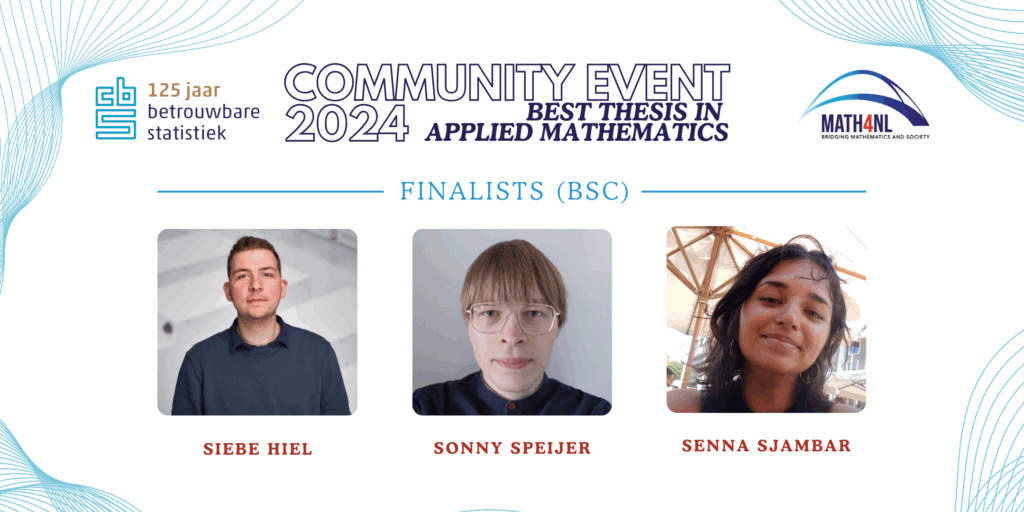
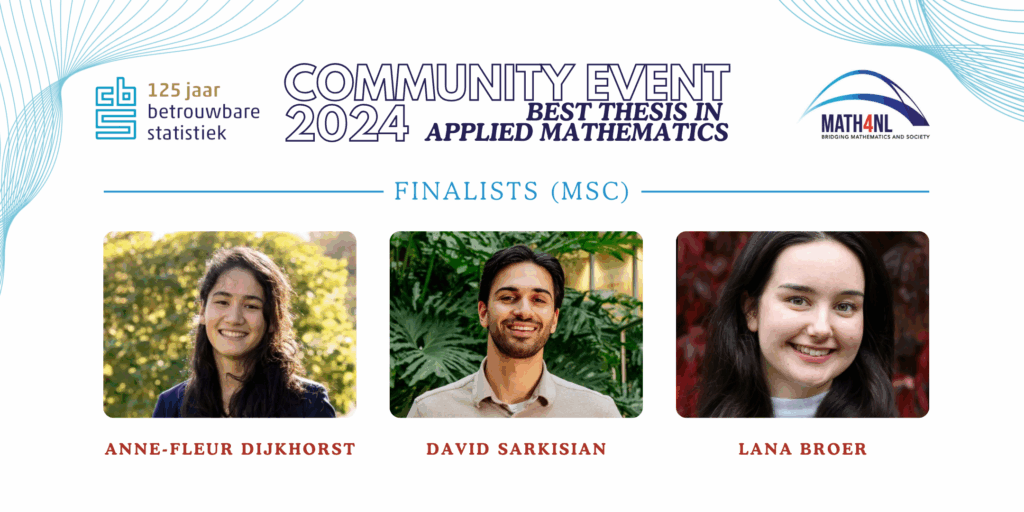
The CWI Best Thesis in Applied Math 2024 goes to Anne-Fleur Dijkhorst and Senna Sjambar.
The finalists of the 2024 CWI Best Thesis in Applied Math Award pitched their work at the Math4NL community event on October 11, 2024. After a long deliberation, the jury for the BSc category chose Senna Sjambar as the ultimate winner and the jury for the MSc category selected Anne-Fleur Dijkhorst. In both cases, the jury was unanimous even though all the candidates did a really great job.
Senna Sjambar from the The Hague university of applied sciences investigated for Haaglanden Medical Center to what extent the amputation outcome in diabetic patients with foot ulcers can be predicted based on patient characteristics. Her thesis was selected for the thorough understanding of the clinical context, the adept application of mathematical techniques and direct relevance for the clinical practice that it displayed. She was chosen as the ultimate winner in the BSc category because her presentation was very clear for everyone to follow and interesting for both mathematicians and a general audience.
The other two finalists for the BSc category were Siebe Hiel from Fontys who helped WeHeat detect anomalous behavior of heat pumps and Sonny Speijer from Amsterdam University of Applied Sciences who contributed to a mathematical model for gut flow incorporating colon physiology for the Swammerdam Institute for Life Sciences.
Anne-Fleur Dijkhorst from Delft University of Technology helped Noria Sustainable Innovators in selecting the best locations to install catching systems for plastic waste removal from waterways. Her thesis stood out for its very clear presentation of both the subject and mathematics and because the results are immediately useful. During the pitch, she showed the same ability to convey her message: the jury selected here mostly for the very lively presentation.
The other two contestants in the MSc category were David Sarkisian from Delft University of Technology who worked on yield curve modelling and forecasting for interest rate risk management for the Dutch State Treasury Agency and Lana Broer from Leiden University, who investigated whether the prognosis of prostate cancer can be assessed from the prostate-specific antigen (PSA) biomarker development in collaboration with Karolinska Institute.
The CWI Best Thesis in Applied Math Award 2024 was made possible by the sponsrs CWI, ChipSoft and Phalanxes.
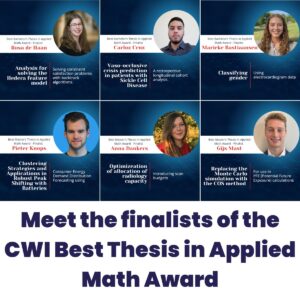
The CWI Best Thesis in Applied Math Award 2023 goes to Rosa de Haan and Pieter Knops.
The finale for the Best Thesis in Applied Math Award took place during the Math4NL Community Event in Leiden. The three finalists in both the MSc category and the BSc category presented their thesis in a brief pitch of only a few minutes.
Rosa de Haan from NHL Stenden Hogeschool Leeuwarden was the winner In the BSc category. For Van Wijnen Components she developed an algorithm that determines feasible combinations of configuration options for apartments. The jury praised the clarity of the presentation, discussing complex math in an accessible way. The jury consisted of Bram van Den Broek and Henri van der Heiden, both from Fontys Hogeschool, and Klaas-Jan Wieringa from NHL Stenden Hogeschool.
The other two finalists in the BSc category were Carloz Cruz from Inholland Hogeschool Diemen, who studied crisis prediction in patients with Sickle Cell Disease for UMC Utrecht, and Marieke Bastiaansen from Fontys Hogeschool Eindhoven, who investigated whether gender could be established from electrocardiogram data for the Catharina hospital Eindhoven.
The winner in the MSc category was Pieter Knops. He worked on the forecasting of (the distribution of) consumer energy demand to make better use of batteries. This work was done for Energyworx. The jury selected Pieter because his presentation struck a good balance between what he did and how he did it, with just the right amount of math. The jury for the MSc category consisted of Benjamin Sanderse from CWI, Olga Shevchuk from EY and Mark Roest from VORtech, who is also chairman of the Innovation Committee of the Dutch Platform for Mathematics.
The other two finalists in the MSc category were Gijs Mast from TU-Delft, who showed impressive results for fast potential future exposure calculations, which he investigated for FFQuant, and Anna Dankers from the University of Twente who studied the effect of scan budgets for the allocation of radiology capacity for UMC Groningen.
As in previous years, the juries had a hard time selecting the winner. Already the preselection to determine the finalists led to a lot of discussion as the overall quality of all submitted theses was high. Selecting the final winners was not much easier as all the pitches were convincing. The 2023 edition of the Best Thesis in Applied Math Award once more highlighted the excellent work that is being done and the mathematical talent that goes around in the Netherlands.
We thank our sponsors CWI and Chipsoft for their support to make this award possible.
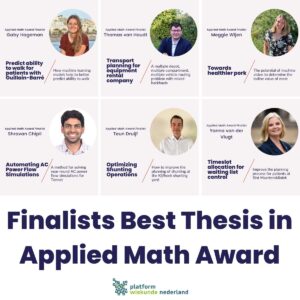
Best Thesis in Applied Math Award 2022 goes to Gaby Hageman and Teun Druijf
The finale for the Best Thesis in Applied Math Award took place during the Math4NL Community Event in Utrecht. The three finalists in both the MSc category and the BSc category presented their thesis in a brief pitch of only a few minutes.
A jury, consisting of PWN director Wil Schilders, Behrouz Raftari Tangabi from ING, and Corine Laan from Amsterdam University of Applied Sciences, made the final decision on the winner in each category.
In the BSc cateogory, the winner was Gaby Hageman. For Erasmus MC, Gaby investigated whether machine learning models could help to better predict whether patients with the Guillain-Barré syndrome are not able to walk independently six months. This thesis was not only selected because the data preparation and model selection were done very thoroughly, but also because Gaby kept the clinical applicability in mind during her research. This results in useful recommendations that are practically applicable.
The other two finalists in the BSc category were Meggie Wijen, who investigated the potential of machine vision to determine a specific characteristic of pork for Vision Partners, and Thomas van Houdt, who developed a planning model for the transport of equipment from each of the locations of Loxam Nederland to their customers and vice versa.
The winner in the MSc category was Teun Druijff. Teun has investigated methods to improve the planning of shunting at the Kijfhoek shunting yard for DB Cargo Nederland. This became an issue now that the operator of the yard has started to provide shunting services to third parties. Teuns work was notable for bridging the gap between practice and mathematics: he nicely translates the shunting operations into a mathematical description and, reversely, gives very practical recommendations for the Kijfhoek shunting yard.
The other two finalists in the MSc category were Shravan Chipli, who developed a method for solving year-round AC power flow simulations for Tennet, and Yanna van der Vlugt, who improved the planning process for patients at Sint Maartenskliniek.
Overall, the quality of the submissions for this award was very high and even selecting the finalists was hard, as was the selection of the winners. This speaks of the very high-quality mathematics research that is done for Dutch companies and institutes.
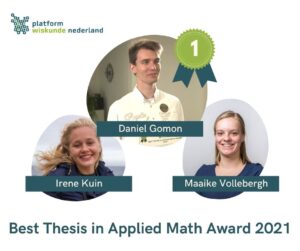
Best Thesis in Applied Math Award 2021 for Daniel Gomon
At the first Math4NL Community Event the Best Thesis in Applied Math Award 2021 was awarded to Daniel Gomon for his thesis “Continuous time control charts: generalizations and an application to the Dutch Arthroplasty Register (LROI)”.
Daniels research was aimed at early identification of quality problems in transplantation surgery for the LROI (Landelijke Registratie Orthopedische Implantaten). According to the jury his presentation was clear, also for (relative) layman. The jury especially liked how Daniel showed the pros and cons for each of the methods he had analysed. The Dutch Arthroplasty Register will implement the result of Daniels work, faster detection of problems in the health care around hip prostheses, as soon as possible in order to improve the quality of care.
Maaike Vollebergh and Irene Kuin, the other finalists, also received praise from the jury for their work and presentation. The research of Irene took place in the challenging environment of the judiciary, where mathematics is not commonly used and data availability is limited. She did however develop a method within an Approximate Dynamic Programming framework for the optimal scheduling of law cases. The success of this work is clear as the judiciary is going to fund two PhD-students for follow-up.
Maaike Vollebergh showed with a simple pictogram why the current planning model of the Netherlands Railways doesn’t work optimally. She introduced a new methodology which she tested on the rail network of Noord Holland. The results are promising and the Netherlands Railways already had another master student performing follow-up research.
We congratulate all three finalists for their excellent work and presentation.